Vidéo IA : où on en est vraiment (4 exemples concrets)
Un workflow complet pour générer des vidéos IA avec Seedance 2.
– 11 min read
Un workflow complet pour générer des vidéos IA avec Seedance 2.
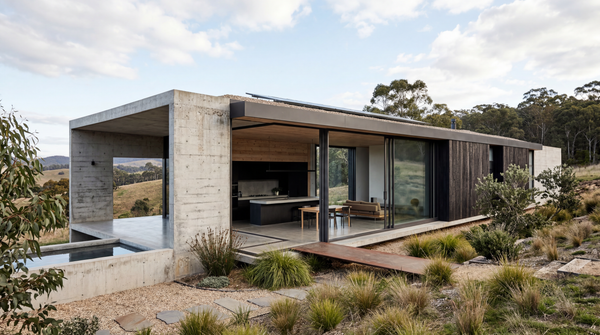
Les stars de la vidéo ne sont pas celles de l’image. Nano Banana (Gemini) et ChatGPT savent générer de la vidéo, mais le grand gagnant du moment côté qualité, c’est Seedance 2.0 (ByteDance), suivi de Kling.
Tous les exemples que tu vas voir sont faits avec Seedance, accessible notamment via Weavy, la même interface nodale dont je parlais la semaine dernière pour l’image. Attention quand même : la vidéo, ça coûte cher en crédits. Compte plusieurs centaines de crédits pour 5 à 15 secondes selon le modèle et la résolution.
Quel que soit le cas, la mécanique est toujours la même :
Cette histoire de références change beaucoup de choses. Comme avec Nano Banana, tu peux nourrir le modèle d’images qui guident le style, l’ambiance, les matériaux. C’est ce qui permet de garder la cohérence avec un projet existant.
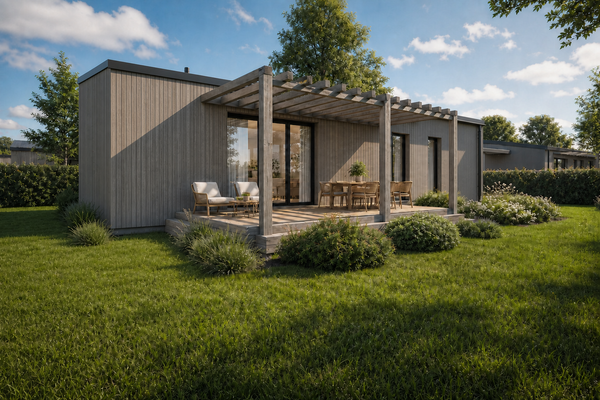
Le plus simple, mais celui qui va te servir 80 % du temps. Je reprends une des images validées la semaine dernière, je la passe en first frame (ca sera donc la première image de la vidéo, et je demande à Seedance de créer un travelling lent de 10 secondes (avec un prompt un peu long généré par Claude):
@Image1 as the first frame.
Shot on ARRI ALEXA 35, 35mm lens, aerial drone footage. 16:9.
Natural color grading, late afternoon golden light, faint film grain.
0.0s–10.0s: Slow aerial tracking shot — drone moves laterally from right to left at 25 meters altitude, gently revealing the residential development of identical wood-clad single-story houses with solar panels on dark metal roofs, each surrounded by manicured lawn and trimmed hedges. The composition keeps the central house in the foreground while neighboring units pass slowly through the background.
Movement: gimbal-stabilized, very slow constant lateral drift, no rotation, slight forward parallax.
Animation cues — subtle natural motion only:
Mature tree canopies sway softly in a gentle breeze Hedge tops ripple gently
Long shadows of trees shift imperceptibly on the grass
Two or three slow cumulus clouds drift across the sky
Light flickers softly through the leaves of the foreground tree
Parked cars remain static, no movement on the road
No people visible
Audio: ambient outdoor atmosphere only — soft summer wind through foliage, distant birdsong, very faint countryside ambience, no music, no voice-over, no traffic noise.
Style: high-end real estate promotional cinematography, serene and aspirational, late afternoon natural daylight, soft contrast, photorealistic textures on wood cladding and solar panels.
Maintain architectural alignment of all buildings, no distortion of roofs or hedges, photorealistic geometry, stable horizon, consistent shadows throughout the shot.
Single continuous take, no cuts.
4K Ultra HD, Rich details, Sharp clarity, Cinematic texture,
Natural colors, No blur, No ghosting, No flickering, Stable picture.
On voit le découpage avec la description de la video : le type de mouvement, le style et aussi l'audio car les vidéos IA ont maintenant le son. Il faut donc aussi décrire la musique ou le fond sonore d’ambiance.
Résultat : la cohérence de style est tenue. Je répète l’opération sur chaque image de la série, et je monte le tout dans un éditeur vidéo et j’ai un clip d’une minute à partir de mes 10 images photoréalistes.
Là, on change complètement de registre. Pas d’image de référence. Juste du texte pour créer une vidéo expérimentale et voir comment le modèle s'en sort.
Voici le prompt :
Duration: 15 seconds. Aspect ratio: 16:9 Mode: T2V. One continuous stabilized dolly shot forward at constant pace.
Style anchor: De Stijl architectural interior, inhabitable Mondrian composition. Flat planes in pure primary colors — crimson red, cobalt blue, cadmium yellow — separated by thick matte black orthogonal bars and pure white planes. Lacquered matte surfaces, no visible texture, no grain. Right angles only — no curves, no diagonals, no ornament. Diffuse soft overhead studio lighting, no cast shadows anywhere. Deep focus throughout.
[00.0s–03.5s] CHAMBER 1 — Camera opens inside a white rectangular chamber framed by thick matte black bars at ceiling and floor. A tall crimson red panel fills the right third of the frame. The red panel slides laterally leftward and exits frame-left; simultaneously a cadmium yellow panel pushes in from the right edge and locks into the same screen position.
[03.5s–07.0s] CHAMBER 2 — The camera advances through a black-bar threshold into a second chamber. Two cobalt blue panels meet at a perfect right angle on the left wall. As the camera moves forward, the left blue panel slides downward into the floor, revealing a deeper white volume; a yellow ceiling panel slides into view from above to close the top frame.
[07.0s–10.0s] FLOOR TRANSITION — The dolly continues forward at the same constant pace. The floor beneath the camera transitions from white to crimson red as horizontal floor panels slide laterally underneath the camera path.
[10.0s–15.0s] FINAL JUNCTION — The camera reaches a junction where four colored panels (red, yellow, blue, white) converge around a central black cross on the back wall. All four panels retract outward simultaneously in synchronized motion, opening the space into a pure white volume crossed by thick black orthogonal bars. The camera settles, centered and locked on the final composition, holding for the last second on perfect geometric symmetry.
Spatial discipline: panels move on invisible tracks hidden behind the black bars. Only the panels move — the camera maintains constant forward velocity, locked horizontal axis, no whip, no shake, no rotation, no tilt.
Material continuity (locked throughout): matte lacquer surfaces stay perfectly flat. Primary colors stay pure and saturated (crimson red, cobalt blue, cadmium yellow) — no gradient, no shading, no reflection, no fading. Black bars stay thick, matte, and orthogonal. White planes stay pure white. The architecture recomposes itself like a living Mondrian around the camera path.
Audio: subtle mechanical sliding — panels gliding on hidden tracks, soft pneumatic releases at each panel lock, low ambient room tone, no music, no voice.
Final frame: pure white volume crossed by thick black orthogonal bars, camera centered, perfect geometric symmetry, no remaining colored panels visible.
4K Ultra HD, Rich details, Sharp clarity, Cinematic texture, Natural colors, No blur, No ghosting, No flickering, Stable picture. Realistic panel sliding mechanics, perfectly flat lacquer surfaces, no morphing, no texture drift.
Claude génère un prompt structuré avec des time codes. Et c’est ça qui devient intéressant : Seedance peut générer jusqu’à 15 secondes avec plusieurs plans dans une seule génération. Tu lui donnes ta structure de montage dans le prompt (par exemple : « 0-3s plan A, 3-7s plan B avec transition, 7-15s plan C zoom »), et il sort une vidéo déjà montée.
Tu as fait shooter un projet livré ? Tu as 10 belles photos ? Tu peux maintenant en faire une vidéo de présentation propre.
Le principe : tu charges plusieurs photos comme références, tu dis à Seedance laquelle utiliser à quel moment, et il crée une suite de plans sur 15 secondes en mouvement, à partir de tes photos réelles. On est donc plus sur une vidéo de 3 secondes à partir d'une image mais 15 secondes avec tous les plans qui provienne des photos.hotos.
Vidéo générée à partir d'un ensemble de photos
Il y a un léger glissement entre la photo et la vidéo générée mais on est arrivé à un niveau utilisable en pro, par exemple pour ajouter des séquences vidéo à un site internet d’agence, ou une vidéo de présentation projet.
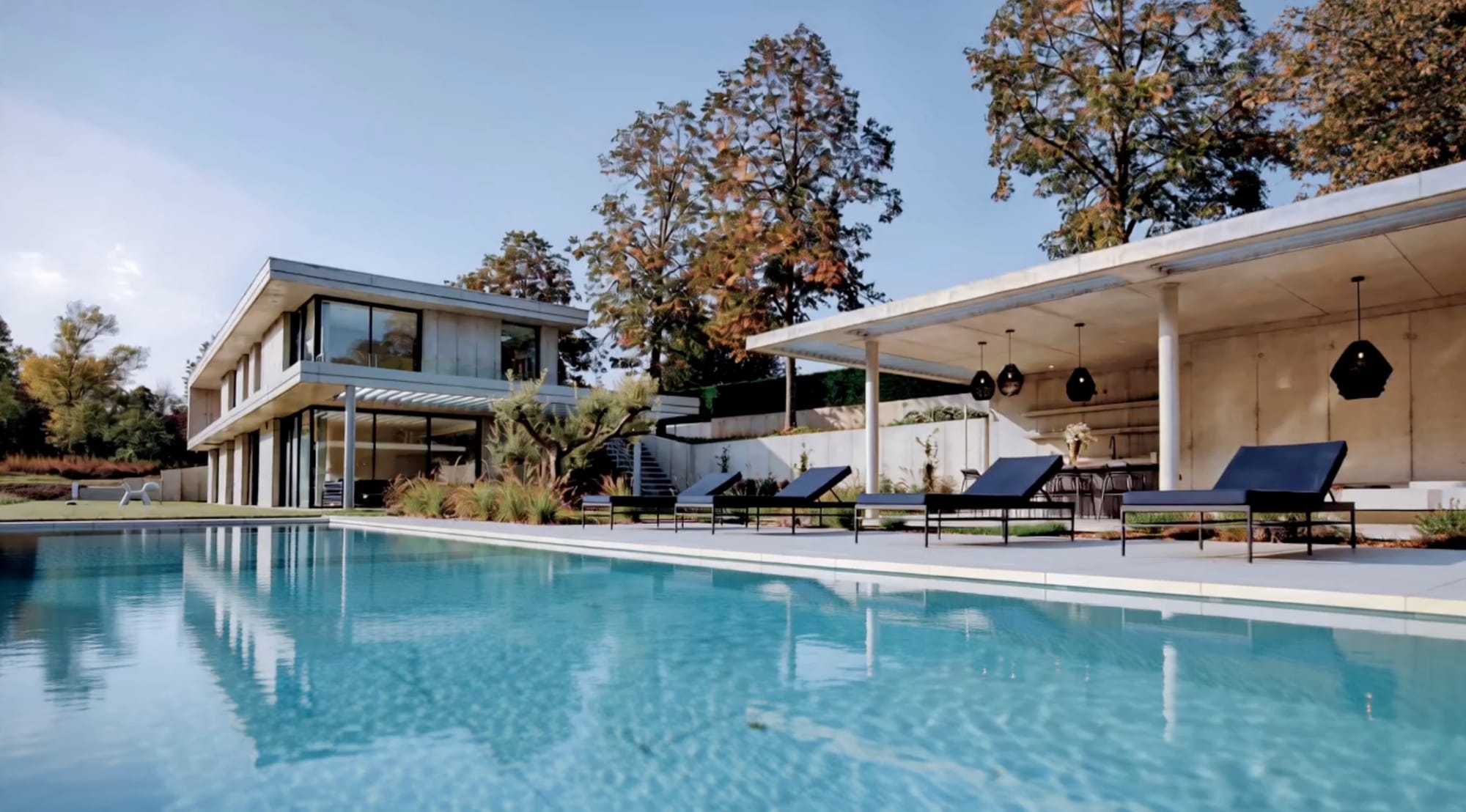
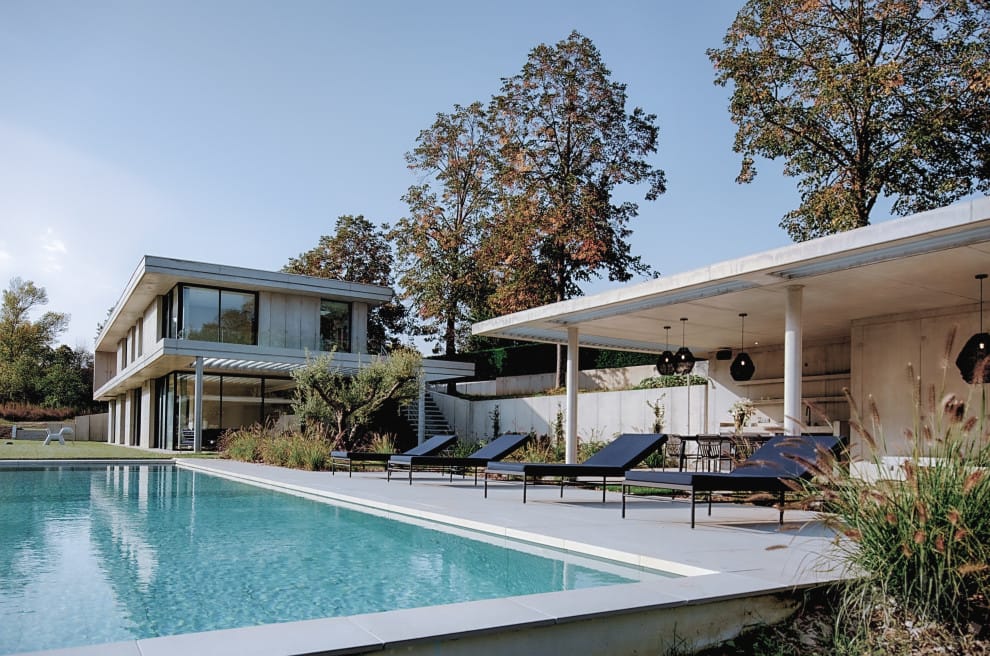
A droite la photo d'origine, à gauche le point de vue dans la vidéo
Les photos sont visible sur mon site : https://miwa.archi/projects/5914932
Le prompt :
Duration: 15 seconds. Aspect ratio: 16:9. Five separate shots with cuts between beats. R2V using 9 image references.
Reference plan:
@IMG_11 : identity reference for the exterior — board-formed concrete facade, covered terrace, cantilevered flat roof.
@IMG_2 : material reference for raw concrete and full-height glass bays.
@IMG_3 : final frame anchor — floating wood staircase against raw concrete wall.
@IMG_4 : hero reference for the pool, black sun loungers, covered pool house.
@IMG_5 : approach reference for the facade walkway and garden.
@IMG_6 : interior threshold — living room with full-height glass doors.
@IMG_7 : context wide for the facade scale and grounds.
@IMG_8 : hero reference for the open kitchen with marbled stone island.
@IMG_9 : kitchen extension — Eames chairs, wood dining table.Architectural anchors (locked throughout): concrete keeps the pale grey board-formed texture from @IMG_11 and @IMG_3 . Wood keeps the warm light-oak tone from @IMG_8 . Marble island keeps the dark veined pattern from @IMG_8 . Glass bays remain transparent with realistic reflections. Materials, geometry, and 5500K light temperature stay identical across all five shots.
[00.0s–03.5s] SHOT 1 — Wide low-angle 24mm. Slow gimbal glide right-to-left across the concrete facade and covered terrace from @IMG_11 . Foreground: lawn. Midground: terrace beams. Background: glass bays. Only foliage and shadows move.
[03.5s–06.5s] SHOT 2 — Medium-wide 35mm. Slow forward push-in toward the pool from @IMG_4 . Pool surface reflects sky, black sun loungers screen-right, pool house in background. Only water ripples move.
[06.5s–09.0s] SHOT 3 — Forward dolly through the open glass door frame from @IMG_6 , with focus rack from outdoor reflection to indoor warm wood floor. Realistic glass physics, no fish-eye, no warp.
[09.0s–13.0s] SHOT 4 — Medium 35mm lateral glide inside the open kitchen from @IMG_8 G_8 and @IMG_9 G_9. Marbled stone island center-frame, dark wood cabinetry screen-left, Eames chairs and dining table screen-right. Pendant lights stay still.
[13.0s–15.0s] SHOT 5 — Static hold with subtle 5-degree tilt-up, revealing the floating wood staircase against the raw concrete wall from @IMG_3 . Soft daylight grazes the treads. Frame holds centered, concrete wall filling the upper third.
STYLE: Architectural Digest editorial, slow architectural storytelling. Shot on ALEXA Mini LF, 24mm and 35mm, restrained color grade, desaturated greens, warm woods, deep blacks, subtle film grain. Lighting: soft overcast daylight, neutral 5500K, diffuse natural light, no golden hour, no sunset.Camera: slow controlled gimbal glide, locked horizontal axis, no whip, no shake, no real estate flythrough, no aggressive drone, no fish-eye, no time-lapse.
Audio: subtle ambient — light breeze in foliage during shots 1 and 2, soft room tone inside during shots 4 and 5, no music, no voice, no real estate jingle.
4K Ultra HD, Rich details, Sharp clarity, Cinematic texture, Natural colors, No blur, No ghosting, No flickering, Stable picture. Realistic glass physics, accurate concrete texture, accurate wood grain, no morphing surfaces.
Celui que je trouve le plus impressionnant : je prends une seule image générée et je demande à Seedance, uniquement à partir de cette image, de générer plusieurs points de vue de l’espace : recul, contre-plongée, traveling latéral, plan large.
Et ça marche quasiment parfaitement en raccord avec l’image d’origine, sans que je lui donne aucune autre vue. Je donne des direction sur les points de vues ue je trouve pertinent et claude écrit le prompt.
Video à partir uniquement de la première image
@Image1 as the first frame — use for house architecture, materials, and site context.
Shot on ALEXA Mini LF, 40mm anamorphic lens. 2.39:1. 24fps.
Natural color grading: muted earth tones, warm amber highlights, deep clean blacks,subtle 35mm film grain. The Local Project editorial style — architectural documentary.MUSIC BED (plays continuously across all shots, low volume, sits under ambient sound):
Warm lo-fi chill instrumental — soft dusty vinyl crackle, mellow Rhodes electric piano chords, muted jazz guitar, lazy brushed drums around 70 BPM, subtle upright bass, faint tape hiss. Nostalgic, cozy, meditative. No vocals. No drops. Same track throughout, smooth and uninterrupted.0.0s–2.0s: Slow aerial drone push-in — reveals the house nested in its landscape, trees gently swaying. Golden hour side-light rakes across the facade, casting long shadows.
Audio: distant wind through foliage, faint birdsong, ambient outdoor air, layered over the lo-fi music bed.
2.1s–4.5s: Ground-level slow dolly-in — camera glides toward the main entrance at shoulder height, shallow parallax revealing depth between landscape foreground and architecture. Light volumetric dust particles drift in sunbeams.
Audio: soft footsteps on gravel, rustle of grass, breathy ambient wind, music continues.
4.6s–7.0s: Interior locked-off wide shot through a large glazed opening — sunlight pours across a timber floor in geometric patches, curtains move with light wind. A single human silhouette passes slowly in the deep background, out of focus, for scale.
Audio: muted interior acoustics, soft timber creak, distant birds through the glass, lo-fi music softens slightly to feel more intimate indoors.
7.1s–9.5s: Macro slow tracking shot gliding along a honed stone kitchen countertop — camera skims low across the surface, revealing the stone's veining and matte texture in the foreground, walnut cabinetry warm and softly blurred on the side, and a large floor-to-ceiling glazed opening pulling focus in the background as the camera approaches — the outdoor landscape opens up like an invitation to step outside. Golden light spills
across the stone from the window.
Audio: subtle ambient kitchen tone, faint breeze through the open doorway beyond, soft birdsong filtering in from outside, music continues warmly underneath.
9.6s–12.0s: Slow vertical crane-up from eye-level to rooftop — reveals the relationship between the built form and the surrounding sky, one architectural line leading the eye upward. Sun flares gently across the lens at the apex.
Audio: ambient wind lifting, warm tonal swell of outdoor space reopening, music gently breathes with the reveal.
STYLE NOTES: Contemplative, meditative pacing. The camera observes, never performs.
Light is the main character — it moves through the space like water. Negative space is sacred. Nature and architecture breathe together. Lo-fi music sits low in the mix ambient sounds always lead, music supports the mood without overpowering the space.
Single continuous cinematic flow, smooth gimbal and slider transitions, no handheld shake.
Maintain architectural consistency with @Image1 across all frames — same materials, same geometry, same light direction. No distortion, no warping of straight lines, no added decorative elements. Natural smooth movements.
Sharp architectural clarity,
Natural muted colors, No blur, No ghosting, No flickering, Stable picture.
Concrètement, ce que ça change : il suffit d’avoir 2-3 images validées d’un projet (intérieur, extérieur, vue principale), et tu peux générer des plans vidéo de points de vue que tu n’as jamais modélisés. La cohérence est tenue par le modèle.
Là, on peut imaginer ce que ça peut donner dans un futur proche : 3 images photoréalistes validées avec le client, puis 30 secondes de vidéo.
Trois choses sur la vidéo IA :
Si cet article t’a été utile, partage-le à un confrère ou une consœur qui pourrait en tirer quelque chose.
À la semaine prochaine, Steven